What is a tea ceremony?
Share
Tea brewing - a history of tradition
Green tea was brought to Japan from China in 1191 by the Buddhist monk Eisai. And it was he who also initiated the ritual of preparing tea powder. He described the whole thing in a special treatise "On Drinking Tea for Health." The title of this work, by the way, reveals the main idea that guided the monks in performing the whole ceremony. The brewing of tea and its drinking was primarily intended to have a positive effect on a person's body and soul.
Over time, the tea ceremony went beyond the monastery walls and became popular also among Japanese merchants and warriors. At the same time, its function also changed. It became the focal point of lavish social gatherings, lavish parties and loud, often alcohol-laced revelry. It was accompanied by singing, poetry recitations and riddles.
Everything changed again around the 16th century, when the three following monks Shukō Murata, Jōō Takeno and Sen no Rikyū significantly reformed the tea-brewing ritual, giving it a much deeper, philosophical meaning and encasing it in strict aesthetic rules.
Wabi-sabi, or philosophy, and tea brewing
Sen no Rikyū, who studied Zen, embedded the tea ceremony precisely in this philosophy. In this view, preparing and drinking the beverage was meant to be an act on the path to enlightenment. The influence of this thinking can be found throughout the ceremonial and aesthetic side of the ritual, which is still maintained today
In the spirit of simplicity, minimalism and lightness. These are also qualities close to the concept of Wabi-sabi - an aesthetic category that expresses a subtle admiration for the transience and impermanence of the world. That's why the tea ceremony should take place in an atmosphere of tranquility, peace and concentration, and in a space that is conducive to these states. Hence, it also lacks decorative elements - the only exception may be a vase with flowers chabana and kakemono - A vertical painting with a delicate floral motif or a calligraphed sentence.
How does the tea ceremony work?
The traditional tea brewing ritual begins long before the very moment the drink is brewed. It all begins while still in the garden, where the host of the ceremony welcomes the group of guests and the selection of the guest of honor takes place. Then everyone goes for a short walk, during which they admire the subtle beauty of nature and wash their hands and face in a spring, possibly in a bowl of water. Only then do guests enter the chashitsu, the small building where the ceremony takes place. Before the threshold, it is compulsory to remove shoes, and when entering, to bend down, as the entrance is usually a small opening measuring 70×80 centimeters (traditionally, this necessity to bend down was to remind guests that - regardless of their position in society - everyone is really equal). Inside, guests take their seats on tatami mats and are treated to a lightly digested meal, and sometimes sake and wagashi (Japanese sweets with a subtle flavor). Only after these activities does the ceremony host begin the process of brewing tea. It is not uncommon to prepare two separate drinks. One thicker one, which guests drink from the same teapot, and a weaker one, poured into separate teapots. During the ceremony, a solemn yet relaxed atmosphere is mandatory. It is in good taste to talk only about the tea or subtle elements of the decor of the environment.
Tea ceremony set
As the name suggests, tea ceremony is highly conventionalized. It requires performing specific activities in the right order, but also using specific accessories. Among them are:
- cha-gama - a cast iron jug from which boiled and properly cooled water is poured;
- chashaku - bamboo spoon for putting tea;
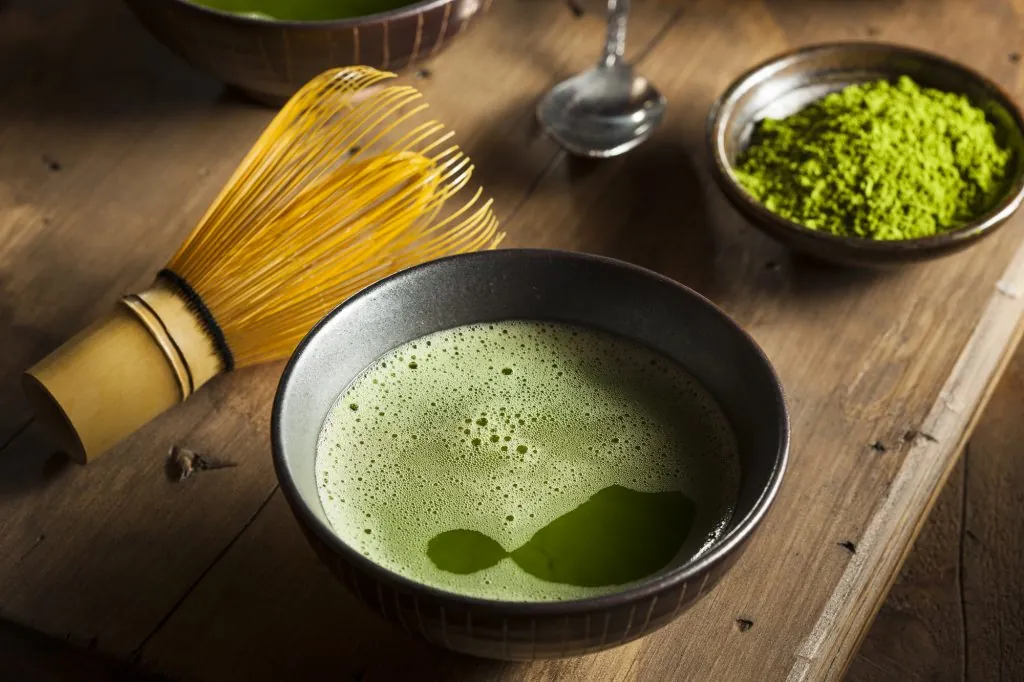
- chasen - a bamboo broom resembling a shaving brush - with its movement
In the shape of the letter W, the drink is mixed.
However, the heart of the entire tea ceremony is... the tea itself - and a very specific one at that: high-grade Matcha tea.
Can the tea brewing ritual be recreated at home?
And yes, and no. Of course, a ceremony is a ceremony. Nothing can replace the one performed in a traditional tea house in Kyoto or any other Japanese locale. However, if we look at the tea-brewing ritual in philosophical and aesthetic terms, we can conclude that any brewing of matcha, or even ordinary green tea, will be a ceremony, as long as we preserve the spirit of the whole ceremony, that is, if we are accompanied by an atmosphere of concentration and reverie.
When and where was the tea ceremony born?
The origins of this ritual date back as far as the 12th century, when the Buddhist monk Eisai proposed a method of brewing a drink based on powdered green tea. The ceremony as we know it today crystallized and solidified in the 16th century.
What kind of tea is used in the ceremony chanoyu?
Exclusively matcha, or powdered green tea.
What makes up a tea ceremony set?
Special kettle, cast iron jug cha-gama, chashaku, which is a bamboo spoon for putting tea on, and chasen - A bamboo broom for stirring the brew.
See our proposal Matchy
Check also
Can you drink green tea while pregnant?
Pregnancy is a time when every expectant mother carefully examines her eating habits and seeks reliable information about the safety of the products she consumes. Expectant mothers often check whether green tea is safe to drink during pregnancy because they want to be absolutely sure that the chosen infusion is completely safe for the baby's health. It's worth knowing the specific rules for its consumption. The most important […]
Does tea raise blood pressure? Everything you need to know
Many hot tea lovers, reaching for their next cup of tea throughout the day, wonder if tea raises blood pressure. The topic of theine's effect on the circulatory system is highly controversial, as the body's response depends on the type of tea and its preparation method. In this guide, we'll explain how different varieties affect blood vessels and help you understand whether your favorite […]

Is tea healthy? Check out its properties and contraindications.
Wondering if drinking tea is healthy as you reach for another cup of your favorite infusion throughout the day? This aromatic beverage has been with us for thousands of years, and modern science is increasingly confirming its unique effects on the human body. In this guide, we'll explore what's hidden in tea leaves, how different varieties support our well-being, and what […]